
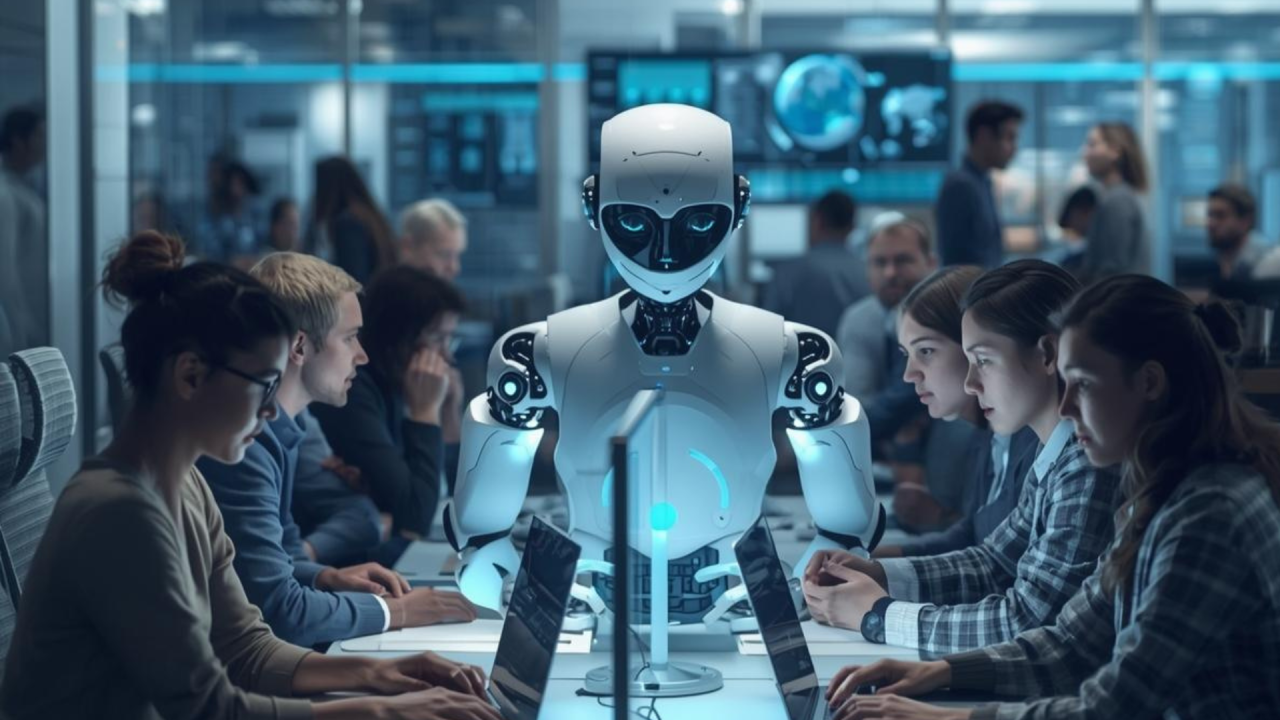
Here is an eighth article, focusing on a more sociological and psychological angle: the mental health impact of automated rejections, the rise of new developer support collectives, and the pivot towards AI ethics and “Human-in-the-Loop” roles.
The Empathy Algorithm: Solidarity and Survival for the Displaced Developer
By AI Correspondent
Behind the glossy announcements of the latest artificial intelligence breakthroughs lies a hidden landscape of immense stress and uncertainty. For the thousands of software developers currently navigating prolonged unemployment, the narrative of “AI as a helpful co-pilot” feels painfully out of touch. Instead, AI has become the gatekeeper to their livelihoods.
As the technical mechanisms of software engineering undergo a radical transformation, so too does the psychological reality of being a tech worker. Today, displaced developers are not just battling an unfavorable economic climate; they are fighting an unprecedented crisis of isolation, forcing a fundamental rethinking of how human coders support one another and find value in an automated world.
The Isolation of the Algorithmic Job Hunt
Losing a job has always been difficult, but the modern tech job search has become uniquely dehumanizing. The very technologies these developers once built are now being used to screen them out of the workforce.
- Faceless Rejections: The standard job application process is now heavily mediated by AI-driven Applicant Tracking Systems (ATS). Unemployed engineers spend hours crafting cover letters and completing rigorous coding assessments, only to be rejected in milliseconds by an algorithm that decided their resume lacked a specific keyword.
- The Ghosting Epidemic: Even when candidates reach the interview stage, the hyper-lean structure of modern tech companies means HR departments are stretched thin. Ghosting—the practice of ceasing all communication without explanation—has become the industry standard, leaving candidates in a perpetual state of anxious limbo.
- The Evaporation of Watercooler Networks: Historically, much of career advancement in tech happened through informal networking—meetups, hackathons, and office socialization. With the rise of remote work and mass layoffs, these physical support structures have collapsed, leaving unemployed developers isolated behind their monitors.
The Rise of Developer Collectives
In response to this profound isolation, a new phenomenon is emerging: the grassroots developer support collective. Realizing that the traditional corporate safety nets have failed them, displaced software engineers are banding together to create alternative communities of survival.
Through platforms like Discord, Slack, and specialized subreddits, unemployed developers are forming tight-knit networks focused on mutual aid rather than mere networking.
- Mental Health Triage: These spaces act as digital group therapy. Developers openly share their struggles with imposter syndrome, financial anxiety, and the depression that often accompanies long-term unemployment, destigmatizing the emotional toll of the AI transition.
-
Skill-Swapping and Co-Working: Instead of competing against each other, developers are forming accountability pods. A front-end specialist might trade portfolio reviews with a back-end engineer, while others host silent, virtual co-working sessions to maintain a sense of routine and discipline.
- Bypassing the ATS: Collectives are pooling their resources to bypass algorithmic filters. Members actively refer one another directly to hiring managers within their extended networks, relying on human vouching to circumvent AI screening.
Pivoting to the “Human-in-the-Loop” Economy
While the sheer volume of coding jobs has shrunk, the displaced developers who are finding their footing are doing so by leaning heavily into the very traits that AI lacks: empathy, ethical judgment, and complex human communication.
Rather than trying to out-code generative models, these engineers are transitioning into “Human-in-the-Loop” (HITL) and governance roles:
- AI Ethics and Compliance: As legislation around artificial intelligence tightens globally, companies desperately need technical experts who can audit AI systems for bias, copyright infringement, and ethical compliance.
- Stakeholder Translation: AI can write the code, but it cannot negotiate with a frustrated client or decipher the vague, often contradictory requirements of a non-technical product manager. Developers are repositioning themselves as “technical translators” who bridge the gap between business needs and automated outputs.
- Data Curation and Quality Assurance: AI models are only as good as the data they are trained on. Experienced engineers are finding work in meticulously curating, cleaning, and verifying the high-quality, niche datasets required to fine-tune enterprise AI systems.
A New Definition of Tech Culture
The struggles of today’s unemployed developers highlight a critical flaw in the tech industry’s traditional value system. For decades, the culture idolized the “10x programmer”—the solitary genius who could write flawless code in a dark room.
The AI revolution has commoditized that archetype. Moving forward, the most resilient tech workers will not be defined by their ability to type syntax faster than a machine. They will be defined by their capacity for human connection, their ethical stewardship of powerful tools, and their willingness to support one another through periods of profound disruption.
Would you like the next article to focus on a specific demographic, such as recent computer science graduates, or perhaps explore the perspective of the companies that are choosing AI over human hiring?
The Lost Generation: AI, Open-Source Decay, and the Displaced Developer
By AI Correspondent
The tech industry was built on a foundation of community. For decades, the ecosystem thrived on a predictable cycle: seniors mentored juniors, developers collaborated on open-source projects for the public good, and online forums served as digital town halls for problem-solving. Today, as Artificial Intelligence reshapes the economics of software development, this communal fabric is unraveling, leaving a growing population of unemployed developers isolated in its wake.
While much has been said about corporate efficiency and hyper-lean teams, a deeper structural crisis is unfolding. The rise of AI coding assistants is not just automating tasks; it is fundamentally disrupting the human networks that have historically sustained the software industry.
The Missing Pipeline and the “Lost Generation”
The most profound casualty of the current hiring freeze is the mentorship pipeline. Historically, a company hired a junior developer knowing they would be a net negative on productivity for the first six months. The return on investment came later, as that junior grew into a capable senior engineer through daily code reviews, pair programming, and human mentorship.
Today, AI models act as tireless, inexpensive juniors. Consequently, the entry-level door has slammed shut.
- A Devastating Gap: Unemployed recent graduates and career-transitioners are finding themselves labeled as a “lost generation.” They possess foundational knowledge but are entirely locked out of the environments required to gain production-level experience.
- The Mentorship Void: For those few who do land jobs, the human element is fading. Instead of asking a senior engineer for help and engaging in a nuanced discussion about system design, juniors are instructed to “just ask the chatbot.” This deprives them of the contextual, architectural wisdom that only comes from human experience.
The Open-Source Battlefield
In previous economic downturns, unemployed developers had a reliable strategy to stay sharp and remain employable: contributing to open-source software. Building a robust GitHub profile by fixing bugs in public repositories was the ultimate proof of competence.
AI has turned this strategy into a nightmare.
- The PR Spam Crisis: Open-source maintainers are currently drowning in a flood of AI-generated Pull Requests (PRs). Desperate to show activity on their profiles, individuals use LLMs to auto-generate thousands of minor, often nonsensical code changes across public repositories.
- Drowning Out Real Talent: For the genuinely skilled, unemployed developer trying to make a meaningful contribution, their work is lost in the noise. Maintainers, overwhelmed by the sheer volume of AI spam, are locking down repositories or ignoring contributions from unknown developers entirely. The traditional avenue for proving one’s worth has been heavily polluted.
The Flight to the Physical
Faced with a software landscape saturated by algorithms, many displaced developers are realizing they cannot out-type an AI. Instead, they are pivoting to the one area where generative models remain effectively useless: the physical world.
We are witnessing a quiet migration of software engineers into hardware-adjacent fields.
- Embedded Systems and IoT: Unemployed web developers are dusting off C++ and Rust to program microcontrollers, sensors, and Internet of Things (IoT) devices. AI struggles profoundly with hardware constraints, memory management, and physical integrations.
- Robotics and Automation Tech: Writing the logic that tells a robotic arm how to sort packages in a warehouse requires an understanding of physics, spatial mapping, and hardware safety protocols—nuances that go far beyond a standard text prompt.
- Industrial Control Systems (ICS): The manufacturing and energy sectors desperately need developers to modernize legacy systems, a field where the cost of an AI “hallucination” could mean a physical catastrophe, thereby mandating human engineering.
Preserving the Core
The current wave of AI innovation is undeniably powerful, but it is acting as a blunt instrument, fracturing the community structures that made the tech industry resilient.
The software engineers currently struggling with unemployment are not just looking for paychecks; they are searching for a place within an ecosystem that seems to have abruptly rejected them. If the industry continues to prioritize algorithmic output over human development, it risks permanently alienating a generation of talent. Technology requires infrastructure, but it also requires a thriving, interconnected human community to guide it. Bridging the gap for these displaced developers is not an act of charity; it is essential for the long-term survival of the craft itself.
The AI Code Mirage: Unemployed Developers and the Looming Technical Debt Timebomb
By AI Correspondent
In the rush to embrace the artificial intelligence revolution, the tech industry has become intoxicated by speed. Today, applications that once took months to prototype can be spun up in a matter of days using Large Language Models (LLMs) and autonomous coding agents. Yet, as companies celebrate record development times and slashed payrolls, a massive demographic of unemployed software developers sits on the sidelines, watching what they believe is a slow-motion trainwreck.
The narrative that AI has seamlessly replaced the need for human engineers is pervasive, driving the current hiring freeze. However, experienced developers who are currently locked out of the market are pointing to a hidden, growing crisis: an unprecedented explosion of technical debt.
The Illusion of Flawless Automation
For corporate executives and non-technical founders, AI coding tools look like magic. You input a prompt, and a fully formed React component or Python script materializes. This has led to the widespread elimination of junior and mid-level roles, under the assumption that a single senior engineer managing an AI is all a company needs.
But unemployed developers—many of whom have spent years untangling messy, unmaintainable codebases—recognize the mirage.
- The “Spaghetti Code” Accelerator: AI models are essentially highly advanced prediction engines. They write code that looks statistically correct, but they do not fundamentally understand the business logic, edge cases, or how a single function interacts with a massive, decade-old legacy system.
- The Hallucination Factor: AI frequently hallucinates plausible-looking but entirely broken libraries or insecure API calls. Without enough human eyes to meticulously review it, this flawed code is being merged into production at lightspeed.
The Purgatory of the Sidelines
For the unemployed developer, this dynamic creates a unique kind of professional purgatory. They are actively watching companies build fragile digital infrastructure, yet they are unable to step in and fix it because the roles designed for code review, quality assurance, and architecture have been cut.
The frustration is palpable across developer communities.
- The Death of Mentorship: The traditional pipeline where junior developers learned by reviewing code and being corrected by seniors is broken. Unemployed recent graduates are finding it impossible to gain the real-world, collaborative experience that actually makes a developer valuable.
- The “Just Use AI” Dismissal: When unemployed engineers express concerns about system stability or security in job interviews, they are frequently met with the assertion that newer AI models will simply “fix the bugs” of the older models. This creates a deeply alienating environment where human expertise is treated as a bottleneck rather than an asset.
The Rise of the “Code Archaeologist”
Despite the current hiring drought, many industry veterans predict that the pendulum will inevitably swing back. As the mountains of AI-generated code age, systems will break, scale poorly, and expose massive security vulnerabilities. When the technical debt comes due, companies will realize that AI cannot reliably debug the very messes it created.
To survive the current freeze, unemployed developers are quietly preparing for this backlash by repositioning themselves not as creators, but as fixers:
- Specializing in QA and Security: Testing is becoming more critical than writing. Developers are upskilling in advanced cybersecurity, penetration testing, and automated QA engineering—skills necessary to audit AI outputs.
- Mastering System Architecture: As AI generates the micro-components, the value of the human lies in the macro. Unemployed engineers are studying cloud architecture, DevOps, and data pipelines to prove they can orchestrate what AI cannot.
- Becoming “Code Archaeologists”: There is a growing anticipation for a new role: the developer who specializes in diving into undocumented, AI-generated “black box” codebases to untangle business logic and rescue failing systems.
A Waiting Game
The tech industry is currently trapped in a honeymoon phase with generative AI, enamored with the cost savings and the sheer speed of output. Unfortunately, the human cost of this phase is being borne by thousands of talented, unemployed developers.
While the short-term job market remains incredibly hostile, the fundamental laws of software engineering have not changed. Bad code eventually breaks. When the mirage fades and the reality of maintaining millions of lines of AI-generated syntax sets in, the industry will once again desperately need the very humans it is currently turning away. Until then, unemployed developers are forced to wait, upskill, and prepare for the inevitable cleanup.